Feb 13, 2026
Why Steel Transport Incidents No Longer Stay Contained
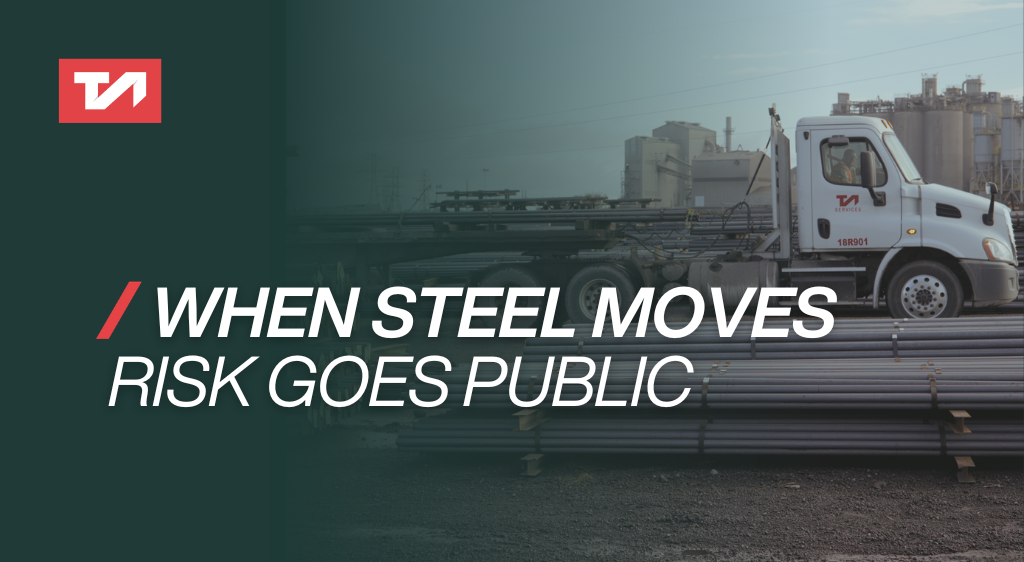
For decades, steel transportation risk was largely treated as a local operational concern.
A missed delivery.
A damaged load.
A sequencing issue.
The impact might disrupt a single plant or customer, but it typically stopped there. Issues were handled quietly, often before anyone outside the immediate operation took notice.
That assumption no longer holds.
Today, steel manufacturers, processors, and fabricators are operating in a fundamentally different environment, one where transport disruptions surface faster, travel further, and draw scrutiny from more stakeholders than ever before.
What has changed is not the existence of risk, but the speed and scale at which exposure now occurs.
The Acceleration of Risk Exposure
Steel transportation has always carried inherent risk. Heavy loads, tight delivery windows, specialized equipment, and complex routing make execution unforgiving. What has changed is not the existence of risk, but how quickly its consequences now surface.
Transport issues are exposed almost immediately, often before full context is available. Scrutiny follows at the same time from customers, insurers, regulators, and internal leadership. What was once a contained operational issue now becomes a reputational one.
That acceleration leaves little room to manage issues quietly.
According to the WTW Global Supply Chain Risk Report, companies have moved their focus away from immediate financial losses toward more enduring risks tied to customer trust and brand reputation. Reputational damage is now cited as one of the top three risks by 66.5% of respondents, a dramatic increase from just 41% two years prior.
When transport incidents surface faster than context, perception forms before explanation.
The New Trade-Off Steel Leaders Face
In the past, organizations had time.
Time to assess what happened.
Time to adjust labor, equipment, and schedules.
Time to communicate before issues escalated beyond the facility or the customer relationship.
That buffer has largely disappeared.
Once a transport issue becomes visible, whether through tracking systems, consignee notifications, insurance inquiries, or regulatory attention, the window to act privately closes. Scrutiny often arrives all at once from:
- Customers
- Insurers
- Regulators
- Leadership teams
- The broader market
Steel leaders now face a clear trade-off: prevent and surface transport risk early, while there is still room to act, or manage the consequences later, once exposure has already occurred.
Visibility Has Changed the Equation
That loss of control has accelerated in recent years.
In late 2025, the Federal Motor Carrier Safety Administration updated its Compliance, Safety, Accountability scoring system. Carrier safety data is now more visible, easier to track, and available in near real time.
Safety performance that once required manual review or delayed reporting is now broadly accessible. In many cases, violations surface before shippers have an opportunity to provide context or respond.
In today’s environment, risk doesn’t wait to be explained.
Why Partners Matter More Than Ever
One of the most important implications of this shift is that steel manufacturers cannot manage transport risk in isolation.
Transportation risk lives across an interconnected network that includes:
- Drivers and carriers
- Dispatch and operations teams
- Consignees and facilities
- Insurers and regulators
- Brokers and service providers
If any part of that network lacks the ability to identify and prevent risk early, the entire system becomes more fragile.
That shared exposure is becoming more explicit. The U.S. Supreme Court is currently reviewing Montgomery v. Caribe Transport, a case that will determine whether shippers and brokers can be held liable under state negligence laws for the selection of motor carriers. If upheld, organizations could face direct liability for accidents involving carriers with known safety violations on their public record.
The implication is clear.
The moment a partnership starts, that risk becomes shared.
Steel organizations are adapting to this reality by prioritizing network-wide risk prevention. Those who aren’t are left reacting after scrutiny has already arrived.
Preparing Your Network for Today’s Steel Transport Risks
As steel transportation conditions continue to change, many manufacturers are taking a closer look at whether their current networks are equipped for today’s level of visibility and risk exposure.
Not just to move freight.
But to protect operations when things go wrong.
As one of North America’s largest flatbed providers, TA Services has spent more than 40 years working within complex, high-risk steel transportation environments. If you’re assessing whether your current transportation network is built for today’s environment, get in touch.
Because in this industry, performance isn’t promised. It’s forged.